Why you need self-reflection to beat procrastination
Let’s start with an uncomfortable truth: procrastination isn’t about being lazy. In fact, smart, ambitious people often struggle with procrastination the most. Why? Because the more difficult a goal is to you, the more likely you are to put it off.
The science behind procrastination
Our brains are wired to prefer immediate rewards over long-term benefits. That Netflix episode gives instant pleasure, while the benefits of working on your side business feel far away. Starting that difficult task requires self-control – the ability to override our impulses and choose the harder path because we know it’s better for us in the long run.
Here’s the catch: self-control is a limited resource. That’s why common advice like “just push through it” or “you need more motivation” rarely works. You can’t rely on willpower alone – it will eventually run out. Especially when you’re an impulsive person.
Instead of depleting your self-control fighting against procrastination, you need to make strategic changes to your environment. Most of the time when we procrastinate, it’s because our environment nudges us toward our old habits. We need to flip this around and create an environment that naturally guides us toward our new habits.
Second, emotional barriers often increase procrastination. Research shows that fear, self-doubt, and perfectionism create a perfect storm for procrastination. When you doubt your abilities or worry about judgment, you’re more likely to put things off. Perfectionists often struggle the most – not the ones with high standards, but those who are constantly worried about meeting those standards.
This explains why traditional advice fails. “Just push through it” or “you need more motivation” doesn’t work because:
- It ignores the natural limits of your self-control
- It doesn’t address the emotional barriers holding you back
- It relies on willpower alone, which eventually runs out
The solution? Stop fighting against these psychological forces and start working with them. This means:
- Designing your environment to require less willpower
- Breaking tasks down to make them less threatening to your perfectionist tendencies
- Creating systems that work even when motivation is low
That’s why we need to focus on practical self-reflection exercises and environmental changes – which is exactly what we’ll cover next.
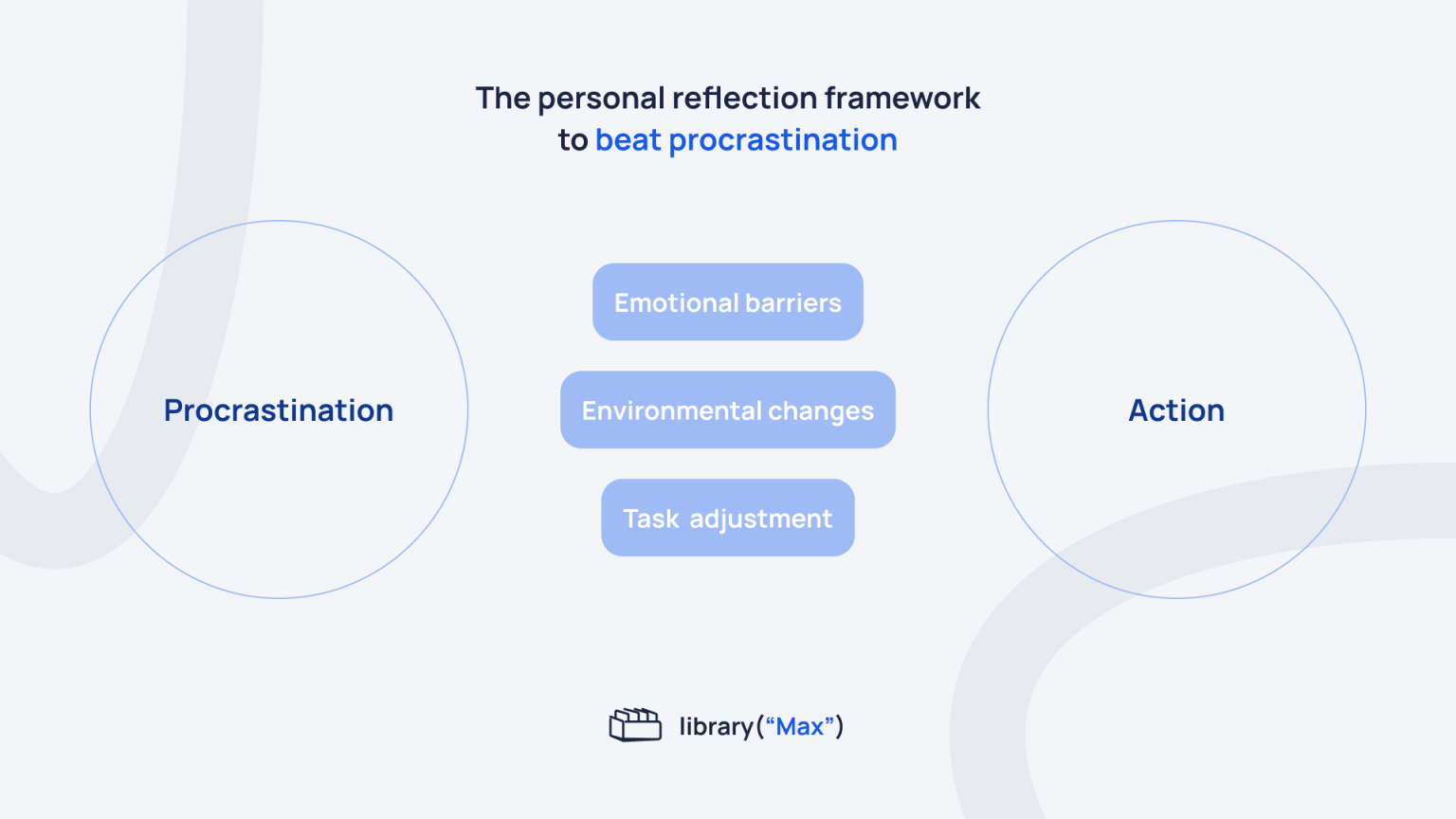
The personal reflection framework to beat procrastination
Your procrastination patterns are unique to you. To break them, you need to recognize your personal warning signs before procrastination takes over. Here are the most common signs that you’re starting to avoid action:
- Finding “urgent” tasks that suddenly need your attention
- Over-planning or getting stuck in research mode
- Waiting for the “perfect time” to start
- Starting multiple projects without finishing any
- Telling yourself “I work better under pressure”
When you notice these signs, pause and ask yourself: “What am I actually avoiding right now?” Often, it’s not the task itself, but a hidden fear or concern. Are you afraid of criticism? Worried about not meeting your own standards? Unsure if you can actually succeed? Those are all emotional barriers that you want to address first.
The key is tracking these patterns. Every time you catch yourself procrastinating, write down:
- What task you’re avoiding
- What you’re doing instead
- What thoughts or feelings triggered the avoidance
After a week, you’ll start seeing patterns. Maybe you always procrastinate on tasks that involve putting yourself out there. Or perhaps you avoid anything that might lead to criticism. These insights are gold – they tell you exactly what barriers and personal beliefs you need to change. Positive beliefs are key when trying to form new habits.
Reflect on your environment: make your habits easier
Let’s see how we can nudge ourselves towards a difficult task. This can be surprisingly simple:
- Writing a blog post? Open an empty document the night before and jot down a few initial ideas. No pressure to start writing – just set the stage.
- Want to exercise tomorrow? Pack your gym bag the night before.
- Trying to eat healthier? Do your weekly grocery shopping in advance and – yes, I’m serious – get rid of all the junk food in your house.
- Want to read more? Place your book on your pillow. You’ll have to pick it up before you can go to sleep.
- Is watching TikTok or instagram how you procrastinate on important tasks? Just delete the damn app for real now.
Small environmental changes like these bypass the need for constant willpower. Instead of fighting against procrastination, you’re creating a path of least resistance toward your desired habits.
If you already used your habit tracker for a while, you could analyze and determine actions that you procrastinated on and write down three environmental changes that you can do to make those actions in your habit tracker easier. Be specific – each change should be something you can implement today.
Never miss twice
The “Never Miss Twice” rule is your secret weapon against procrastination. Here’s why it works: Missing one day of a habit is a slip-up, but missing two days starts a negative pattern. After two misses, your brain starts creating stories: “I guess I’m not a person who can stick to habits” or “This is too hard for me.”
When you miss a day:
- Don’t beat yourself up – this only makes resuming harder
- Focus on the next occurrence of your habit
- Lower the barrier to restart – do an easier version if needed
The goal isn’t to never procrastinate – that’s unrealistic. The goal is to catch yourself earlier, recover faster, and create an environment that makes procrastination less likely in the first place.
Create habits, assess your progress, and reach your goals.
A complete workbook with all the exercises in our personal development plan series.
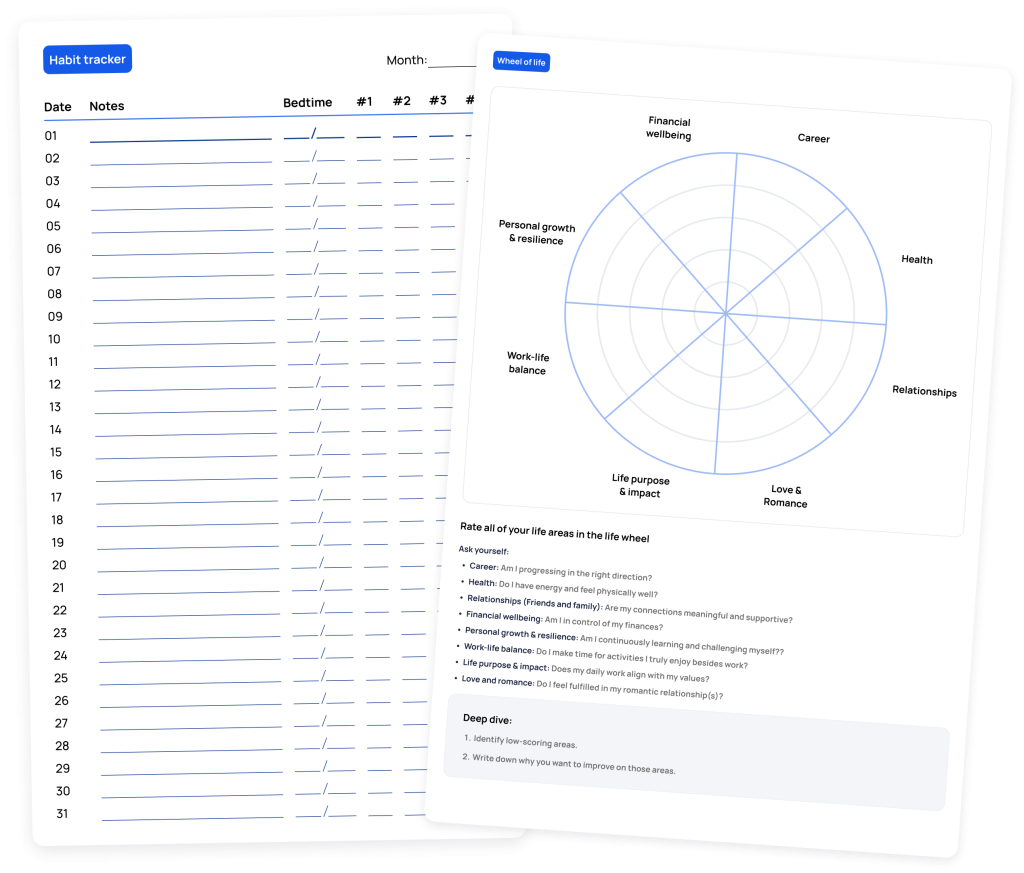
Monthly self-reflection exercises and questions to measure your progress
Regular self-reflection questions are crucial for maintaining momentum in your personal development. But not just any self-reflection – you need a structured approach that turns vague feelings into actionable insights. Here’s a comprehensive monthly self-reflection framework that helps you stay on track and adjust your course when needed.
Life areas review
In the first blogpost of this series you rated different areas of your life. Start by giving your life areas a new score from 1-10:
Did anything change from your previous assessment?
- Specifically look at the areas you wanted to improve on
- Note where you felt satisfied and where you struggled
Which areas need extra attention?
- Identify up to two areas that feel most out of balance
- Be specific about what’s missing or needs improvement
What specific actions can I take to improve these areas?
- Not every improvement needs to be a new habit
- Sometimes a one-time action (like creating a financial overview for financial wellbeing) can make a big impact
Habit performance analysis
Review your habit tracker data honestly:
Which habits am I consistently maintaining?
- Look for patterns in your successful habits
- What nudges or environmental changes make these habits easier to maintain?
Which habits am I struggling with?
- Identify habits with low completion rates
- Are these habits too ambitious or not aligned with your goals?
Should I keep, modify, or release any habits?
- Not every habit deserves to stay
- Sometimes releasing a habit creates space for something more important
How can I adjust a habit with low completion rate?
- Identify your barriers for completing the task
- Write down 3 environmental nudges to make the habit feel more natural
- Formulate an easier version of your habit
Progress and learning reflection
Reflect on your overall development:
What did I achieve this month?
- List concrete accomplishments, no matter how small
- Include unexpected wins and progress
What were my key learnings?
- What strategies worked well?
- What challenges taught you something valuable?
What are my focus areas for next month?
- Set 2-3 specific sub-goals
- Make them concrete and measurable
The power of this reflection framework lies in its regularity. By checking in monthly, you catch issues before they become problems and celebrate progress while it’s happening. This keeps you motivated and helps you adjust your approach before you get too far off track.
Pro tip: Schedule your monthly reflection session like any other important meeting. Block out 30 minutes at the end of each month.
What’s next for your personal development?
In this final part of the personal development plan series, we talked about the psychology behind procrastination. It’s not about laziness – it’s about how your brain responds to challenging tasks through present bias, limited self-control, and emotional barriers like fear and perfectionism. Instead of relying on willpower alone, you can use nudging and strategic environmental changes to naturally guide you toward better habits.
Our monthly self-reflection framework enables you to review your life areas, analyze your habits, and document your achievements and learnings.
Let’s recap what you’ve learned across all the personal development plan blogposts and exercises:
- You started by understanding where you stand with the Areas of Life Wheel assessment
- You learned how to set meaningful goals that align with your values
- You discovered how to transform those goals into consistent habits
- And now, you have learned how self-reflection helps you to beat procrastination and make progress
Personal development is challenging – but you don’t have to do it alone. Join our weekly newsletter where we share:
- Practical insights from top personal development resources
- Featured creators who inspire action
- Tools and guides to support your journey
Create habits, assess your progress, and reach your goals.
A complete workbook with all the exercises in our personal development plan series.