
Why are personal development goals key to your personal growth
Think about the last time you achieved something meaningful. Chances are, you had a clear goal in mind. That’s not a coincidence – but why?
The science behind goal-setting
Let me show you how goal setting changes your behavior – backed by science, but explained in plain language.
When you set clear, challenging goals (not those “I’ll try my best” type), you perform way better than having no goals or easy ones. Why? Because your brain gets laser-focused on what matters.
Here’s what actually happens when you set proper goals:
- They give you a clear direction (no more wondering “what should I do next?”)
- They push you to be persistent try harder and stick with it longer
- They force you to think strategically, get creative and find better ways to succeed
But here’s the catch – not all goals work. If you set them wrong, they can actually make you procrastinate more or lead you somewhere you don’t want to go.
That’s why you need to consider:
- What you’re actually capable of right now
- How committed you really are
- Whether you can track your progress
- What resources you have available
The key? Make your goals challenging enough to excite you, but realistic enough that you won’t give up after two days. Already excited to set your first goals? We got one more thing to do. Let’s review the areas of personal development and what kind of personal development goals align with them.
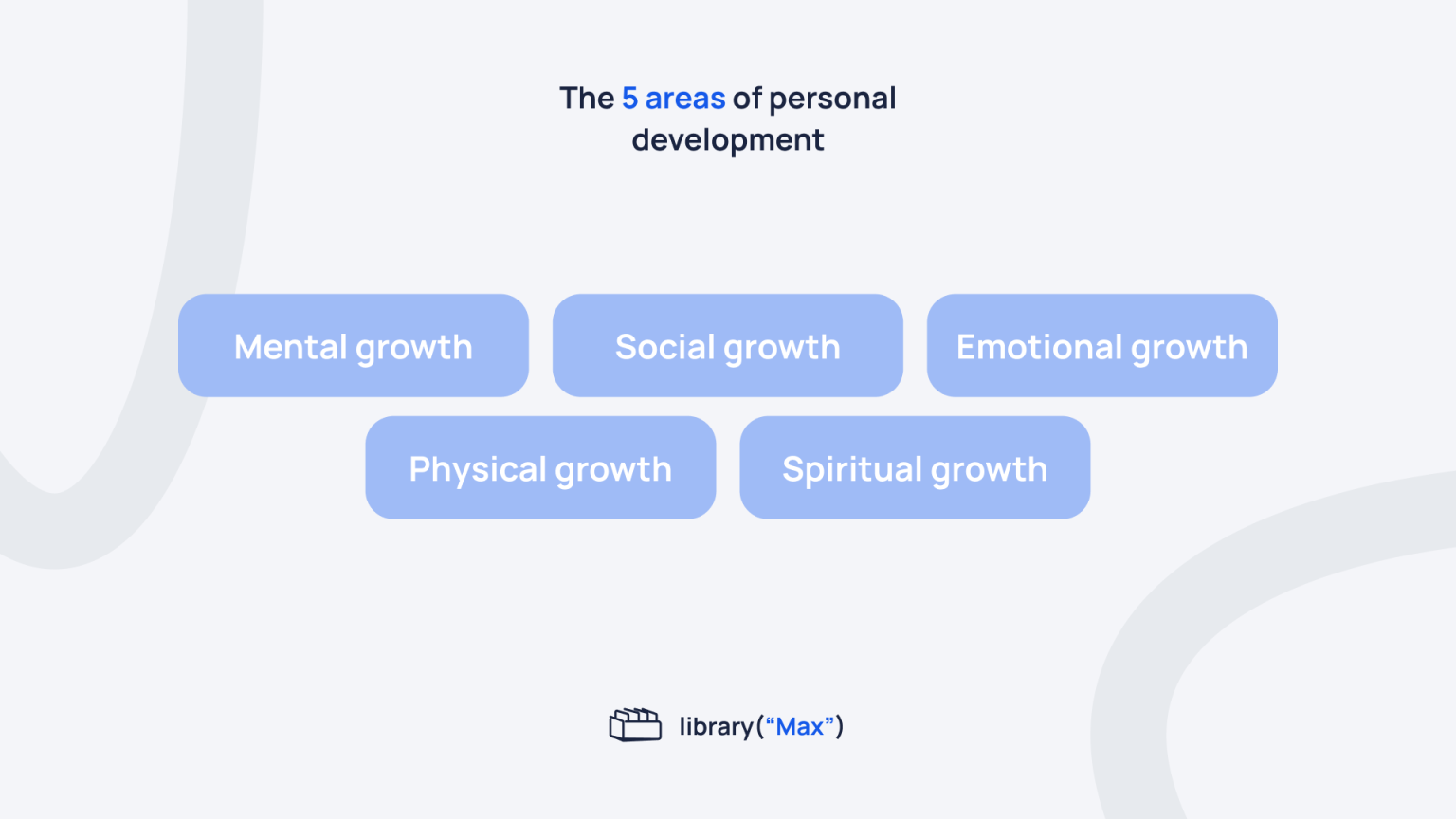
The 5 areas of personal development
You can prioritize different areas in your personal development. What to focus on is up to you. When considering your focus, dial back to your wheel of life assessment in the previous blogpost about starting your personal development plan. Let’s quickly review what kind of meaningful goals you can choose for your personal development plan.
Mental growth
Your brain is like a muscle – train it right and it gets stronger. This is about improving how you think, learn, and solve problems.
Example goals:
- Master a new programming language
- Become fluent in Spanish
- Build expertise in artificial intelligence
Social growth
Being great at what you do isn’t enough – you need to connect with others effectively. This is about becoming better at building and maintaining relationships.
Example goals:
- Become a confident public speaker
- Build a strong professional network in your industry
- Develop leadership skills to manage a team
Emotional growth
Managing your emotions isn’t about suppressing them – it’s about understanding and using them wisely. This helps you stay calm under pressure and build better relationships.
Example goals:
- Develop resilience in challenging situations
- Master conflict resolution skills
- Build unshakeable self-confidence
Physical growth
Your body is the engine that powers everything else. When you feel physically strong, everything else becomes easier.
Example goals:
- Complete a marathon
- Transform your body through strength training
- Master a martial art
Spiritual growth
This isn’t just about religion – it’s about understanding yourself better and finding meaning in what you do.
Example goals:
- Find work that aligns with your purpose
- Develop a deep meditation practice
- Build a life philosophy that guides your decisions
These are the kind of goals that can transform your life. In the next section, we’ll learn how to create goals like these that truly matter to you.
Create habits, assess your progress, and reach your goals.
A complete workbook with all the exercises in our personal development plan series.
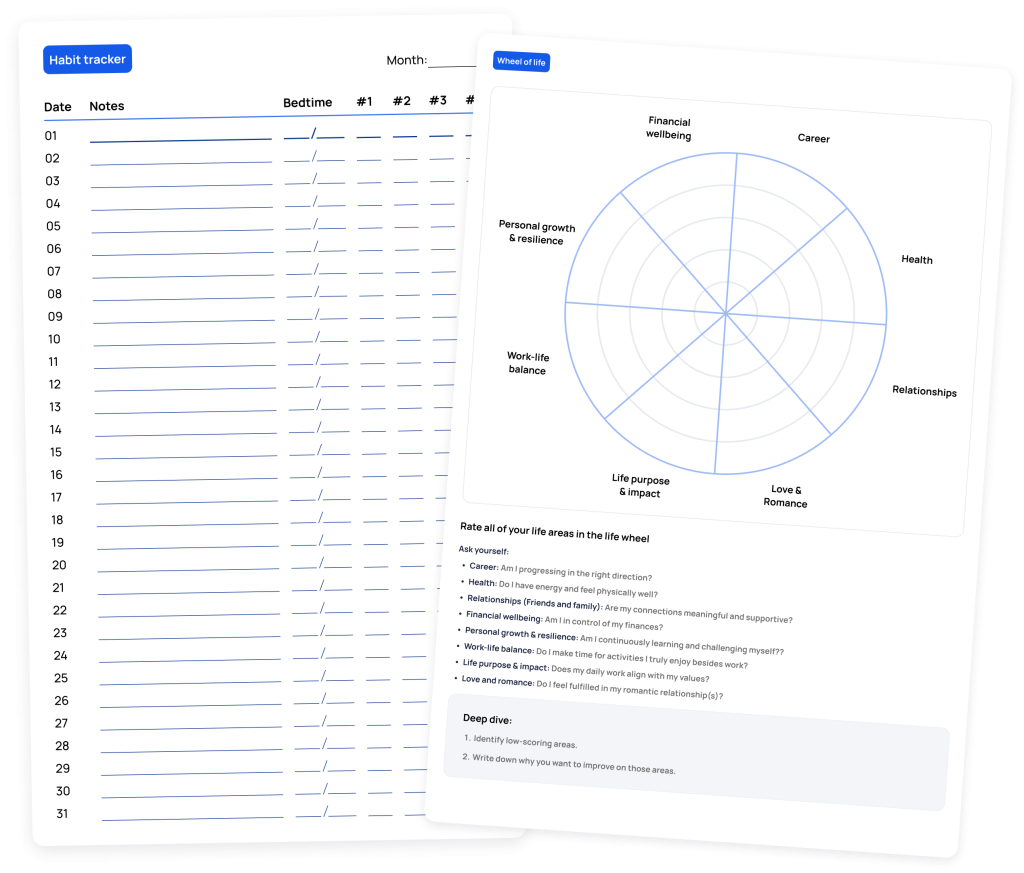
Set meaningful goals with our goal-setting template
Time to turn your ideas into real goals. Not the vague kind that fade away, but clear goals that excite you enough to take action. Let’s build them step by step.
Draft your initial personal development goal
Grab your personal development template and write down what you want to achieve. Don’t worry about making it perfect – just get it on paper.
Exercise 1: Take 2 minutes to write down your initial goal.
Make your personal development goal personal
Here’s where most people mess up – they set goals without understanding their true motivation. Let’s fix that.
Exercise 2: Write this down 5-10 times. “I want to [your goal] because [motivation].”
Be honest with yourself. If you can’t find real reasons that excite you, maybe it’s not your goal but someone else’s expectation.
Test your personal development goal’s size
Is your goal too easy? Too hard? Let’s find out.
Exercise 3: The Goal Ladder
- Write your current goal in the middle of a blank page
- Above it: write 3 easier versions of your goal
- Below it: write 3 bigger, more ambitious versions
- Look at the spread – your goal should feel challenging but not impossible
Does your goal really belong in the middle? If all the bigger goals feel completely crazy, your goal might be too ambitious as well. On the other hand, if all your smaller goals feel really boring, you might need to dream bigger.
Make your goal concrete and measurable
Turn your goal from a wish into a plan. What do you want to achieve and when? At one point, you have know when you succeeded. Vague goals sound like this:
“I want to build a successful side-hustle.”
Exercise 4: Transform your goal
Write down your goal in the following format: “I will [specific achievement] by [specific date]”.
Your goal must be so clear that anyone could look at it and know exactly when you’ve achieved it.
Pro tip: Don’t skip any of these steps. Each one removes a common reason why goals fail – lack of motivation, wrong difficulty level, or being too vague to act on.
Ready to make your goal even stronger? In the next section, we’ll check if it aligns with your values and the person you want to become.
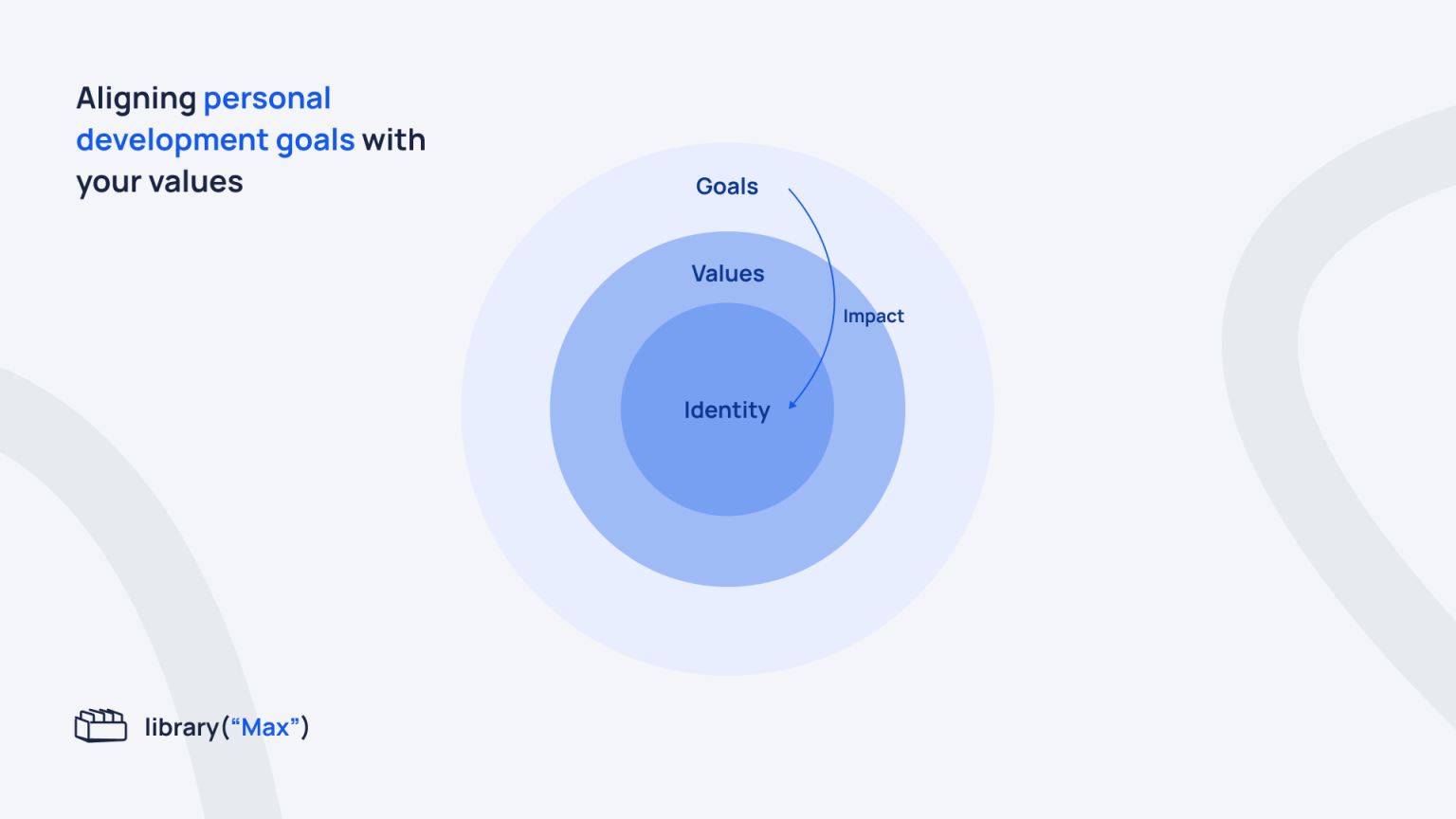
Aligning personal development goals with your values
Now that you’ve set a goal, we want to make sure you’re chasing the right goals – ones that align with who you really are and who you want to become. This isn’t just another checklist exercise. It’s about making sure you’re not wasting time on goals that look good on paper but don’t matter to you.
The identity check
Before asking “What do I want to achieve?”, ask yourself: “Who do I want to become?”
Exercise 1: Identity alignment
- Write down your goal
- Now write: “This goal will help me become someone who…”
- Does this identity excite you? Or does it feel like you’re trying to be someone else?
For example:
- Weak alignment: “I want to become a manager because that’s the next logical career step”
- Strong alignment: “I want to become someone who helps others grow and achieve their potential”
The values test
Time to check if your goal matches what truly matters to you.
Exercise 2: Values alignment
- What are your top 3 personal values? (Think: What principles guide your best decisions?)
- How does your goal support or conflict with these values?
- If your close friends heard about this goal, would they say “That’s so you!” or “That’s surprising”?
The society vs. self check
Let’s be honest – sometimes we chase goals because we think we “should.”
Exercise 3: The real motivation check
- Would I still want this if nobody knew I achieved it?
- Am I excited to work on this, or just excited about what others will think?
- Does this goal feel like a pressure or a choice?
The impact of your goal
Remember your Wheel of Life from the first post? Let’s use it.
Exercise 4: The impact on areas in your Life Wheel
- How will achieving this goal affect areas in your life wheel?
- Will it improve the areas you want to develop?
- Might it harm other important areas?
Write down both positive and (if possible) negative impacts. For example, if your goal is to start a business:
- Career: Major positive impact
- Health: Potential negative impact if work hours are too long
- Relationships: Need to plan for balance
After all these checks, you have three options:
- Keep the goal – it aligns perfectly
- Adjust the goal to better match your values
- Drop it and find a goal that truly matters to you
Remember: It’s better to catch misaligned goals now than waste months chasing something that won’t fulfill you.
Next up, we’ll turn your goal into specific actions. What do you need to do to achieve your goal. However, we have one more exercise for you.
Setting anti-goals for motivation
Before we wrap up, let’s try one more powerful exercise – creating anti-goals. These are the things you specifically want to avoid, and they can make your positive goals even clearer.
Why anti-goals matter
Sometimes it’s easier to know what you don’t want than what you do want. Anti-goals help you:
- Clarify your true priorities
- Stay motivated when things get tough
Set your anti-goals
For one last time we will review the goal you’ve set, answer the following questions.
What situation are you trying to move away from?
For example:
- Goal: “Build a location-independent business”
- Anti-goal: “I never want to be stuck in a 9-5 job where I have to ask permission to travel”
What outcomes do you want to avoid at all costs?
For example:
- Goal: “Develop stronger leadership skills”
- Anti-goal: “I don’t want to become the kind of leader who micromanages their team”
What habits or behaviors do you want to leave behind?
For example:
- Goal: “Build a consistent exercise routine”
- Anti-goal: “I don’t want to keep making excuses about being too busy for my health”
What's next?
Let’s wrap up. In this blogpost you learned why goal setting works, what areas of personal development you can focus on, how to create meaningful goals and aligning them with your values.
You’ve now:
- Created a meaningful goal
- Checked if your goal aligns with your values
- Identified what you want to avoid
In the next blogpost, we’ll turn these goals into an actionable plan. We’ll break down your goals into small, manageable steps and create a system to track your progress.
Create habits, assess your progress, and reach your goals.
A complete workbook with all the exercises in our personal development plan series.